
Claude Opus 4.6 Agent Teams Are Here: How AI Agents Are Transforming Video Understanding with BibiGPT
Claude Opus 4.6 introduces Agent Teams and Adaptive Thinking, but AI agents still can't watch videos. BibiGPT bridges the gap with AI video summarization across 30+ platforms, Agent Skills integration, and source-traced video Q&A for the agentic AI era.
Claude Opus 4.6 Agent Teams Are Here: How AI Agents Are Transforming Video Understanding with BibiGPT
Anthropic just dropped Claude Opus 4.6 with Agent Teams, Adaptive Thinking, and a 1M token context window — and the AI world is buzzing. But here is the thing: even the most advanced AI agents still cannot "watch" a video. They excel at text but are blind to the richest knowledge format on the internet. BibiGPT solves this by giving AI agents the power to summarize, analyze, and interact with video content across 30+ platforms, from YouTube to Bilibili to TikTok and beyond.
What Claude Opus 4.6 Agent Teams Bring to the Table
Quick Answer: Claude Opus 4.6 introduces multi-agent orchestration (Agent Teams), 1M token context with 76% multi-needle retrieval accuracy, and a Compaction API that prevents context degradation in long-running agents — making it the most capable agentic AI model to date (March 2026).
The battle between GPT-5.4 and Claude Opus 4.6 has dominated AI headlines this month. Here is what makes Opus 4.6 stand out for agent workflows:
- Agent Teams: Multiple Claude instances collaborate on complex tasks, with a lead agent coordinating sub-agents for parallel execution
- Adaptive Thinking: The model automatically adjusts reasoning depth based on task complexity — light tasks get fast responses, hard problems get deep chain-of-thought
- 1M Token Context Window: Process entire codebases, book-length documents, or hours of meeting transcripts in a single pass
- Compaction API: Solves the "context rot" problem where long-running agents gradually lose track of earlier instructions and context
These capabilities make Claude Opus 4.6 a formidable foundation for building AI agent systems. But there is a critical gap.
The Video Understanding Gap: Why AI Agents Need BibiGPT
Quick Answer: AI agents built on large language models operate in the text domain. Video content — the fastest-growing knowledge medium — requires specialized transcription, multi-platform access, and structured summarization that general-purpose agents cannot provide. BibiGPT fills this gap.
Even with a 1M token window, Claude Opus 4.6 (and GPT-5.4, for that matter) cannot directly consume video content. The challenges are fundamental:
- Videos are not text: Agents need video content converted to processable text (transcripts, subtitles) before they can reason about it
- Platform fragmentation: YouTube, Bilibili, Douyin, TikTok, Xiaohongshu — each platform has different content access methods and APIs
- No structured output: Even with a transcript, agents struggle to produce timestamped, chapter-organized, highlight-annotated summaries
- Multilingual barriers: Cross-language video transcription and summarization requires specialized pipelines
BibiGPT, trusted by over 1 million users with over 5 million AI summaries generated, supports 30+ platforms and provides exactly these missing capabilities.
BibiGPT Agent Skills: Giving Your AI Agent Video Superpowers
Quick Answer: BibiGPT's Agent Skill (bibi CLI tool) enables any AI agent platform — including OpenClaw and Claude Code — to directly invoke BibiGPT's video summarization engine via command line, no manual intervention required.
BibiGPT's Agent Skill is purpose-built for the agentic AI ecosystem. Here is how it works:
- Install the BibiGPT desktop client, which automatically sets up the
bibicommand-line tool - Your AI agent calls
bibicommands to summarize any video URL — YouTube, Bilibili, podcasts, or local files - Compatible with OpenClaw, Claude Code, and other major agent platforms
Real-World Workflow Example:
Imagine you are using an AI agent to compile an industry research report. You instruct the agent to find 10 relevant YouTube analysis videos. Through BibiGPT's Agent Skill, the agent batch-summarizes all videos, extracts key insights and data points, and compiles them into a structured research document — without you ever opening a single video.
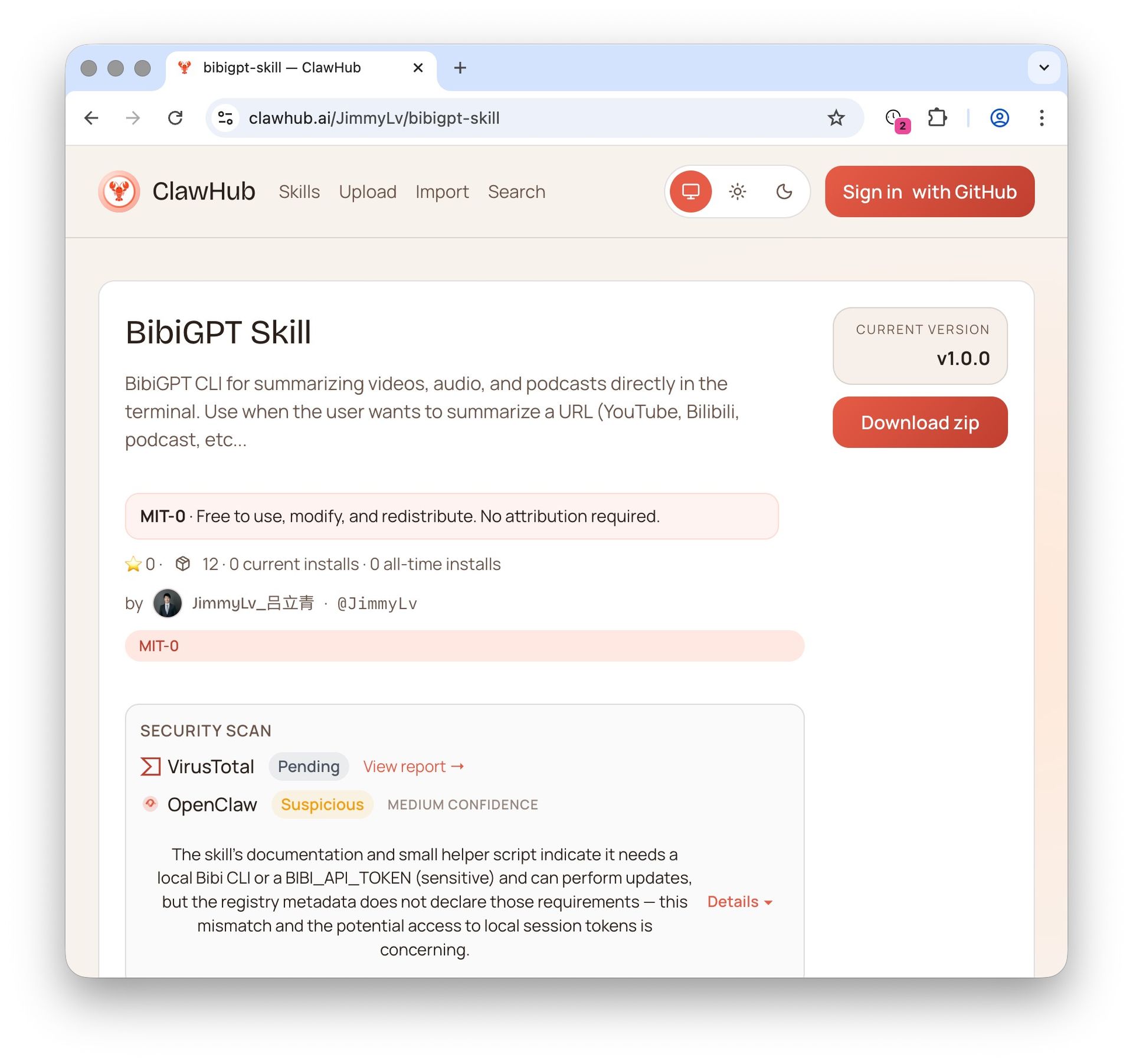 BibiGPT Agent Skill on ClawHub
Learn more about how the BibiGPT Agent Skill empowers video workflows.
AI Video Chat with Source Tracing: Deep Understanding Made Verifiable
Quick Answer: BibiGPT's AI video dialogue feature enables interactive Q&A with video content, where every AI response includes clickable timestamps linked to the original video segments — ensuring accuracy and traceability.
One of Claude Opus 4.6's core improvements is reducing hallucination through better grounding. BibiGPT takes the same principle further for video content with its AI Video Chat & Source Tracing feature:
- Interactive video Q&A: Ask any question about a summarized video and get precise, context-aware answers
- Timestamp source tracing: Every answer includes clickable timestamps — hover to preview the exact video segment
- Full source review: View all video segments cited in the AI's response for complete traceability
- Smart question suggestions: AI automatically recommends 3 deep-dive questions related to the video content
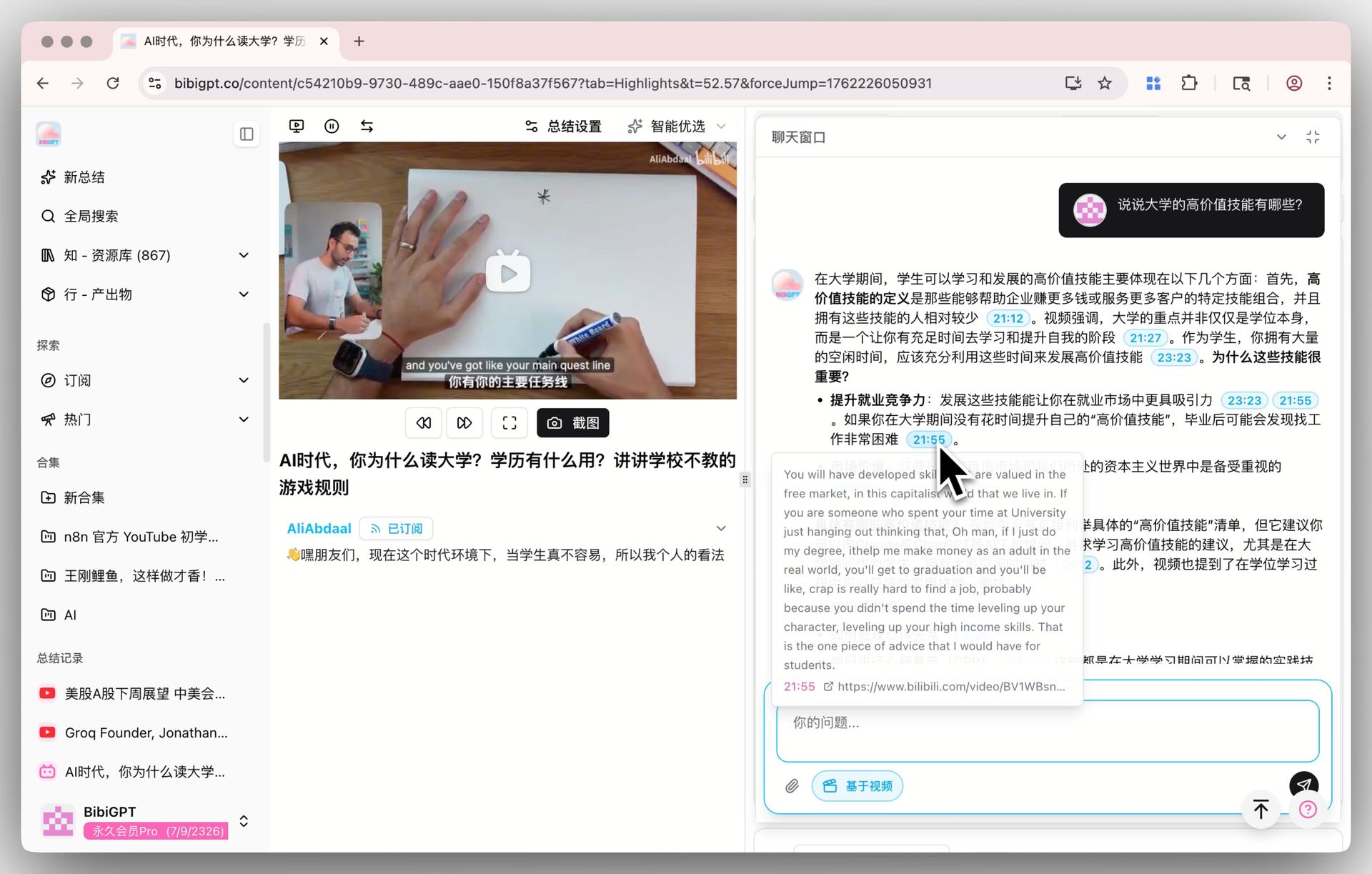 AI Video Chat with Source Tracing demo
This "conversational video understanding" is exactly the interaction paradigm that the agent era demands. Explore more about AI video Q&A and deep understanding.
Why BibiGPT Is the Perfect Companion for the Agent Era
In a rapidly evolving AI agent ecosystem, BibiGPT offers three differentiated advantages that no general-purpose LLM can match:
30+ Platform Coverage
From YouTube to Bilibili, Douyin to TikTok, podcasts to cloud drive files — BibiGPT provides unified video understanding across 30+ platforms. While most tools only support YouTube, BibiGPT ensures your agents can process content from any major platform.
Discover more about AI YouTube video summarization and AI video-to-article conversion.
Structured Output + Multi-Format Export
BibiGPT does not generate simple text paragraphs. It produces structured deep summaries with core takeaways, highlights, thought-provoking Q&A, and terminology explanations. Export to Markdown, PDF, or TXT for seamless integration into agent pipelines.
Source-Traced Video Q&A
When agents need to dig deeper into video content, BibiGPT's dialogue feature provides verifiable answers with timestamp citations — every conclusion traceable to a specific moment in the video. This is essential for research, report writing, and knowledge synthesis.
Practical Workflow: Agent + BibiGPT in Action
Here is a step-by-step agent workflow powered by BibiGPT:
- Discovery: Agent searches YouTube and Bilibili for videos on your research topic
- Processing: Agent uses BibiGPT Agent Skill (
bibiCLI) to batch-summarize all videos - Analysis: Agent leverages BibiGPT's AI chat to ask follow-up questions on key points
- Synthesis: Agent compiles summaries and Q&A results into a structured research report
- Distribution: Use video-to-article features to convert highlights into publishable content
Throughout this workflow, BibiGPT serves as the agent's "eyes and ears" — transforming a text-only agent into one that truly understands audiovisual content.
FAQ
Q1: Which agent platforms does BibiGPT's Agent Skill support?
A: BibiGPT Agent Skill currently supports OpenClaw and Claude Code, with extensibility for more platforms. Simply install the BibiGPT desktop client, and the bibi CLI tool becomes available for any agent to invoke.
Q2: How fast can an agent process videos through BibiGPT?
A: BibiGPT has generated over 5 million AI summaries and is optimized for speed. Typically, pasting a video URL yields a timestamped structured summary within 30 seconds, with support for Chinese, English, Japanese, and Korean output.
Q3: Does BibiGPT support local video files for agent processing?
A: Yes. Beyond 30+ online platforms, BibiGPT supports local audio and video file upload and summarization. Agents can use the bibi command to process local files — ideal for meeting recordings, course captures, and offline content.
Conclusion: In the Agent Era, Video Understanding Should Not Be a Blind Spot
Claude Opus 4.6 Agent Teams represent a massive leap forward for AI agent capabilities. But if your agents can only process text while ignoring video — the richest knowledge medium on the internet — you are leaving enormous value on the table. BibiGPT, trusted by over 1 million users, is the professional video understanding layer that the agent ecosystem needs.
Whether you are a developer building agent workflows, a researcher synthesizing video sources, or a knowledge worker optimizing your learning pipeline — integrate BibiGPT Agent Skills today and give your agents the ability to truly understand video.
Start your AI efficient learning journey now:
- 🌐 Official Website: https://aitodo.co
- 📱 Mobile Download: https://aitodo.co/app
- 💻 Desktop Download: https://aitodo.co/download/desktop
- ✨ Learn More Features: https://aitodo.co/features
BibiGPT Team